
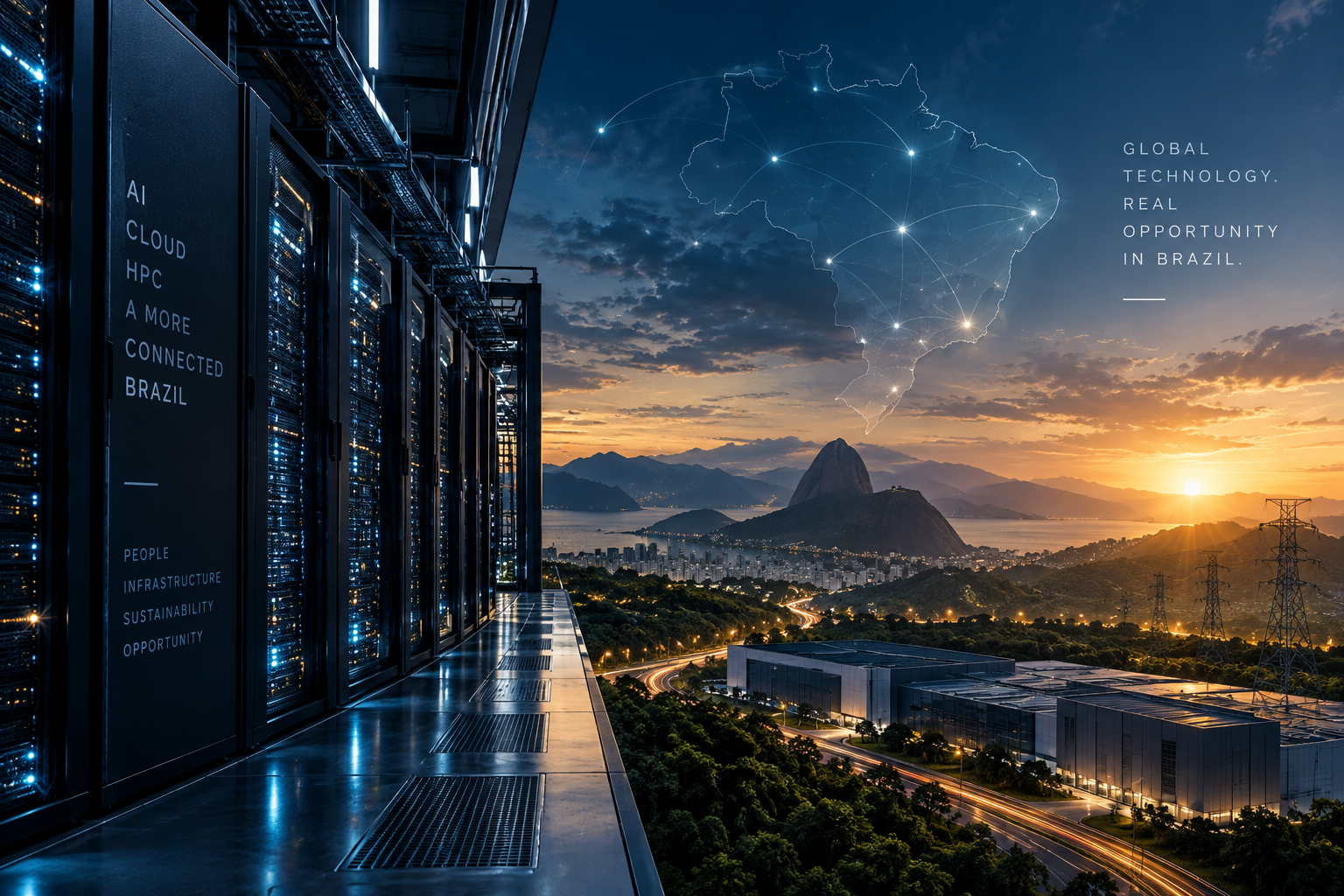
The AI revolution may live in the cloud. Its infrastructure definitely does not.
For the last few years, artificial intelligence has mostly been discussed as software. Models. Agents. Applications. Productivity.
But underneath every AI interaction sits something decidedly physical: enormous amounts of computing equipment, electricity, cooling infrastructure, networking hardware and, increasingly, purpose-built data centers.
And that physical layer is expanding quickly.
Global electricity consumption from data centers grew around 17% in 2025, according to the International Energy Agency. Electricity use from AI-focused data centers grew even faster — approximately 50% in the same year. The IEA's central scenario sees total data-center electricity consumption rising from roughly 485 TWh in 2025 to around 950 TWh by 2030.
That changes the conversation.
The AI race is no longer only about who develops the best model. It is increasingly about who can build the infrastructure required to run it.
And that brings Brazil into an interesting position.
Brazil Just Made a Significant Move
On September 15, 2026, Brazil enacted Law No. 15,504, establishing the Regime Especial de Tributação para Serviços de Datacenter — REDATA.
The regime covers data-processing infrastructure supporting areas including cloud computing, high-performance computing and the training and inference of artificial-intelligence models.
This matters because one of the longstanding challenges of developing technology infrastructure in Brazil has been the cost of bringing sophisticated equipment into the country. Servers are only the beginning.
Modern data centers require an ecosystem of hardware: computing systems, networking equipment, power distribution, cooling infrastructure, storage, monitoring systems, backup equipment and an enormous range of components required to keep everything running.
REDATA attempts to change part of that economic equation...But there is an important distinction.
Making equipment more economically viable to acquire is not the same thing as making a data center economically viable to operate.
That is where the story becomes more interesting.
The New Data Center Equation Has More Than One Variable
For years, discussions about data-center location tended to emphasize connectivity, real estate and proximity to customers.
AI is changing the weight of the variables.
Power is becoming strategic infrastructure.
Data centers represented approximately 1.5% of global electricity consumption in 2025. The IEA expects that share to reach around 3% by 2030. In some markets, the impact on incremental electricity demand will be substantially larger.
The broader electricity market is already feeling the pressure. The IEA expects global electricity demand to grow 3.6% in 2026 and 3.8% in 2027, with expanding data-center capacity among the structural drivers.
For a new generation of facilities, therefore, the question is no longer simply:
Where can we build?
It is becoming:
Where can we secure large amounts of reliable, competitively priced electricity — and continue securing it for decades?
Brazil has an interesting card to play here because of the importance of renewable sources in its electricity system.
But available generation and usable capacity at a specific location are not the same thing.
Transmission capacity, grid connection, reliability and the time required to make new power available can become just as important as the theoretical abundance of energy.
Then Comes Water. And Cooling. And Efficiency.
More compute means more heat. And more heat means cooling becomes part of the investment thesis rather than simply an engineering specification.
This is particularly relevant as AI workloads increase rack density.
The next generation of data-center projects will therefore increasingly be evaluated as integrated systems:
Compute + Power + Cooling + Connectivity + Real Estate + Regulation + Supply Chain.
Optimizing one while ignoring the others can simply move the bottleneck somewhere else.
And REDATA itself reflects this broader perspective. The new framework combines tax incentives with requirements involving domestic capacity, R&D and environmental criteria, while also creating differentiated incentives intended to encourage projects outside the traditional concentration of digital infrastructure.
That deserves attention. Because the next Brazilian data-center hub may not necessarily look like the last one.
The Part of the Data Center Story Nobody Sees
There is another dimension that receives much less attention. A data center may be digital infrastructure. Building one is an enormous physical supply-chain project.
Thousands of components need to arrive at the correct location, in the correct sequence, with the correct documentation. High-value equipment may travel across multiple countries before installation.
Some components will require replacement. Some will fail. Others will need to leave Brazil for repair and return. Critical spare parts will have to be positioned somewhere. Hardware refresh cycles will create reverse flows.
And all of this will happen while the infrastructure itself is expected to operate with extremely high availability.
That creates an interesting paradox:
The more valuable digital uptime becomes, the more important physical logistics becomes.
REDATA May Reduce One Friction. It Won’t Remove the Others.
This is perhaps the most important point for companies looking at Brazil today. Tax incentives can materially change investment economics. But they do not automatically solve:
- power availability;
- grid connection;
- construction lead times;
- equipment procurement;
- international transportation;
- customs execution;
- installation sequencing;
- spare-parts availability;
- hardware replacement;
- or reverse logistics.
REDATA should therefore be viewed as an accelerator, not as the entire strategy. Brazil has improved one important part of the equation. The market now has to solve the rest.
A Bigger Question Is Emerging
There is a tendency to describe the current movement as a data-center boom. That may actually underestimate what is happening. AI is creating an entirely new industrial infrastructure layer around computing.
The winners in this market may therefore not be defined only by who owns the largest data center. They may include the countries capable of developing the ecosystem around it:
- energy;
- engineering;
- connectivity;
- hardware;
- logistics;
- maintenance;
- repair;
- specialized labor;
- and technology.
That is why REDATA deserves attention beyond its tax provisions.
It signals that Brazil wants to compete for a larger role in the infrastructure behind the digital economy. The law explicitly connects data-center incentives with domestic technological development, R&D and regional investment.
Whether Brazil converts that opportunity into a lasting competitive advantage will depend on what happens next. And that story is only beginning.
Next episode
AI Is Digital. Its Infrastructure Is Surprisingly Physical.
We’ll go underneath the cloud to examine what an AI data center actually requires — from GPUs and high-density racks to power systems, liquid cooling, networking equipment and the increasingly complex global supply chain behind them.